
Event Details
Father Felix Raj delivers special lecture on development economics
Department of Economics of St. Xavier’s University, Kolkata (SXUK) organised a special lecture on September 2, 2025 at the university campus.
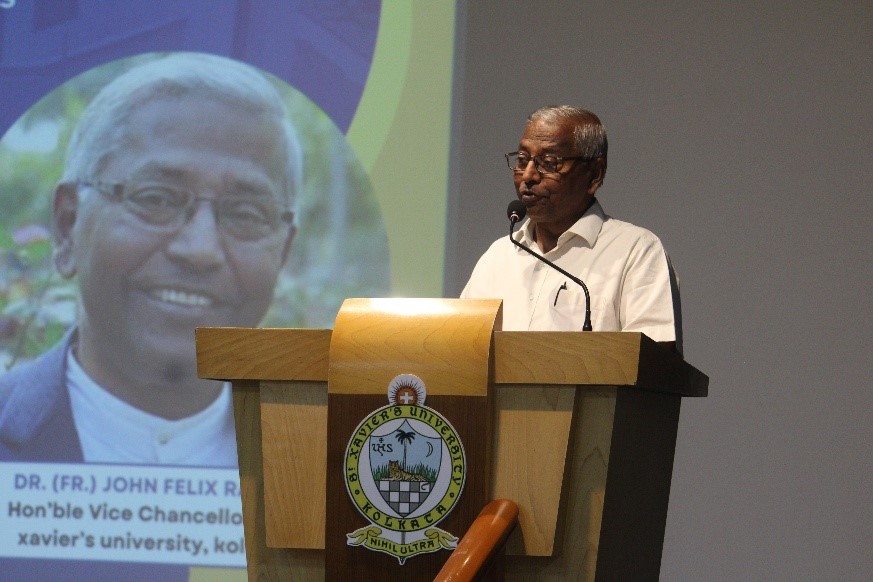
Rev. Dr. John Felix Raj, S.J., the Vice-Chancellor of SXUK was the esteemed speaker. The theme was “Issues in Development Economics”. The session explored moral, social, and economic dimensions of development and highlighted the need to move beyond conventional measures of growth.
Father Felix Raj began his lecture by contrasting negative and positive criticisms, pointing out how Indian institutions often emphasise inefficiencies, whereas in the United States of America, institutions focus on strengths and possibilities. He further addressed the changing times, noting how Artificial Intelligence (AI) is restructuring, reinventing, and redefining society while situating it within a hierarchy of intelligences: divine, human, and artificial.
He said, “We are born in a society which is divided into the global North and South, continents, and racial groups, despite the ideal of one earth.” He further added, “GDP is not an adequate indicator of development. Alternative measures like HDI, literacy, gender equality, per capita income, and happiness indices provide a more holistic understanding.”
While highlighting India’s challenges, Father Felix Raj said, “Only 40% of the population works to sustain the whole, while 7.5% of the population lives on less than one dollar a day.”
To distinguish growth from development, Father Felix Raj compared Libya, where oil extraction benefitted only a few elites, with South Korea, which achieved inclusive development.
The lecture concluded with a discussion on the Bandung Conference (1955), where developing countries sought collective strategies for development and laid the foundation for South-South cooperation.
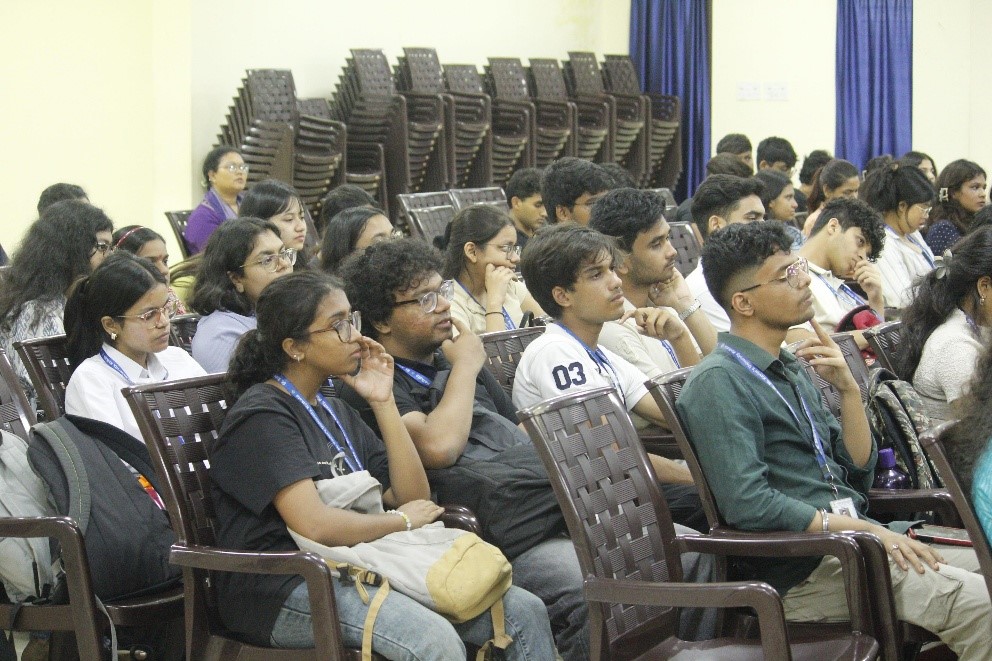
Students found the session thought-provoking. The session encouraged students to reflect on development not merely as an economic concept but as a human and social process rooted in dignity and justice.
Dr. Chayanika Mitra
Event Gallery